

Samsung Washer Repair in Waukegan, IL
Lake Michigan's moderately hard water and the region's exposure to severe summer thunderstorms and derechos create conditions that can damage Samsung washers through mineral buildup and electrical stress from power fluctuations. Waukegan Appliance Repair connects property owners in neighborhoods like Downtown Waukegan and Bowen Park with local independent providers who diagnose and repair Samsung washers quickly, so you're not without laundry capability longer than necessary. Fast local access means less downtime and faster restoration of an essential household appliance.
Samsung Washer Repair Services in Waukegan
Waukegan homeowners rely on their washing machines year-round, but the region's water quality and weather patterns can strain appliances faster than expected. Lake Michigan's moderately hard water leaves mineral deposits that accumulate inside Samsung washers over time, reducing efficiency and triggering error codes. Beyond water chemistry, the Chicago area's severe summer thunderstorms and occasional derechos create power fluctuations that damage electronic components in modern Samsung models. These electrical surges can corrupt control boards, trip sensors, or cause the drum to stop mid-cycle. When your Samsung washer fails, the repair needs to address both the immediate symptom and the underlying cause that Waukegan's local conditions may have triggered.
Waukegan Appliance Repair connects you with independent local providers who understand Samsung washers and the specific challenges they face in this region. These technicians arrive ready to diagnose everything from water inlet valve failures and drum bearing wear to electronic malfunctions caused by power events. They work with genuine Samsung parts and handle the repair thoroughly, then follow up to make sure the machine runs reliably. Whether the issue is simple or complex, getting your Samsung washer back in service keeps your household moving forward without delay.
Common Samsung Washer Error Codes
Samsung documents these twelve codes most often on washers. Seven typically trace to something simple — a blockage, a latch, a setting — and five to a component that needs replacing.
Samsung Washer 4C
Often clearable without a technician
What it means: The washer asked for water and did not get what it expected, so it has stopped rather than run a cycle dry. Samsung shows this as 4C on newer panels, 4E on older ones and nF on some models — one fault, three displays.
Why it happens: Almost always something before the machine rather than inside it: a supply tap not fully open, a kinked fill hose behind the unit, or the small mesh screens where the hoses meet the washer silted up with scale and grit.
What you can check: Check both taps are fully open, then pull the machine out far enough to see the fill hoses are not kinked. If that looks fine, turn the taps off, unscrew the hoses at the machine end and look at the inlet screens for debris.
When to call someone: If the supply is good and the screens are clear, the inlet valve on the machine is next, and that is where it stops being an owner check.
Samsung Washer Ub
Often clearable without a technician
What it means: The load has gone off balance in the tub and the washer will not spin it at speed, because an unbalanced drum at spin speed can damage the machine.
Why it happens: Usually one heavy item on its own — a towel, a bath mat, a single pair of jeans — or a load that has twisted into a rope on one side of the drum.
What you can check: Open the door, redistribute the load by hand and restart the spin. Adding a couple of similar-weight items often settles it; washing one heavy item alone rarely spins well.
When to call someone: If it trips on every load including well-balanced ones, the suspension or the sensor reading the drum may need looking at.
Samsung Washer 4E
Often clearable without a technician
What it means: The same not-filling fault as 4C, shown as 4E on older Samsung panels.
Why it happens: A closed or partly closed tap, a kinked fill hose, or blocked inlet screens where the hoses connect.
What you can check: Work from the wall in: taps fully open, hoses unkinked, then the inlet screens at the machine end.
When to call someone: If water reaches the machine freely and it still will not fill, the inlet valve needs testing.
Samsung Washer SE
Often clearable without a technician
What it means: Water is not leaving the machine at the rate the cycle expects, or is not leaving at all. Shown as 5E, SE, 5C or nd depending on the panel.
Why it happens: The debris filter at the bottom front catches coins, hair grips and lint and eventually packs solid. A kinked drain hose or a standpipe that cannot take the flow does the same thing from further down the line.
What you can check: Open the small flap at the bottom front, drain the residual water into a tray and clean the filter. Then check the drain hose behind the machine for kinks and that it is not pushed too far into the standpipe.
When to call someone: If the filter is clean and the hose run is clear, the drain pump itself needs testing.
Samsung Washer UE
Often clearable without a technician
What it means: The same unbalanced-load condition as Ub, shown as UE on some Samsung models.
Why it happens: A single heavy item, or a load that has bunched to one side of the drum.
What you can check: Redistribute the load by hand and restart the spin.
When to call someone: If balanced loads also trip it, the drum suspension is worth checking.
Samsung Washer dC
Often clearable without a technician
What it means: The washer cannot confirm the door is shut and locked, so it will not start or will stop mid-cycle.
Why it happens: Most often laundry caught in the door seal stopping it closing flush, or a door that has been slammed rather than pushed shut.
What you can check: Open the door fully, clear anything caught around the seal, and close it firmly without forcing it. Check the latch and the strike plate for anything obstructing them.
When to call someone: If nothing is obstructing it and the lock still will not engage, the door lock assembly is the usual cause.
Samsung Washer SUd
Often clearable without a technician
What it means: The washer has detected far more foam than the drum is designed to handle, and is pausing to clear it before continuing.
Why it happens: Usually too much detergent, or a standard detergent used in a high-efficiency machine, which foams several times more than an HE formula.
What you can check: Let the machine run its own suds-clearing routine rather than cutting the cycle short. Next load, reduce the dose and check the detergent is HE-rated if your machine needs one.
When to call someone: If it appears with a correct HE dose, something may be holding water in the drum and it is worth having checked.
Samsung Washer 5C
Often clearable without a technician
What it means: The same not-draining fault as 5E and SE, shown as 5C on some Samsung panels.
Why it happens: A packed debris filter at the bottom front, a kinked drain hose, or a standpipe that cannot take the flow.
What you can check: Clean the filter behind the flap at the bottom front, draining the residual water into a tray first, then check the hose run behind the machine.
When to call someone: If the filter is clean and the hose is clear, the drain pump needs testing.
Samsung Washer nF
Often clearable without a technician
What it means: The washer is not filling — the same fault Samsung shows as 4C and 4E on other panels.
Why it happens: A tap that is not fully open, a kinked fill hose, or the inlet screens where the hoses meet the machine blocked with scale and grit.
What you can check: Check both taps, straighten the hoses, then turn the taps off and inspect the inlet screens at the machine end.
When to call someone: If water reaches the machine freely and it still will not fill, the inlet valve is next.
Samsung Washer OE
Usually needs a technician
What it means: There is more water in the tub than there should be, so the washer has stopped filling and is trying to pump out.
Why it happens: Normally the inlet valve passing water when it has been told to close, rather than anything to do with the load or detergent.
What you can check: Turn the supply taps off at the wall so no more water can arrive. There is no owner-side fix for a valve that will not shut.
When to call someone: Promptly — a valve stuck open is a flood risk as well as an error code.
Samsung Washer 0E
Usually needs a technician
What it means: The same overfill condition as OE, shown with a zero on some panels.
Why it happens: An inlet valve letting water through when it should be closed.
What you can check: Shut the taps at the wall to stop the fill. Nothing else here is an owner check.
When to call someone: Promptly, for the same reason as OE.
Samsung Washer ddC
Often clearable without a technician
What it means: The AddWash door — the small hatch in the main door — is not registering as closed and latched.
Why it happens: It is easy to push shut without seating the catch, and a trapped sock or glove will stop it closing flush.
What you can check: Open the AddWash door fully, clear anything caught in it, and press it closed until the catch engages.
When to call someone: If it is properly shut and still reads open, the hatch switch needs checking.
Samsung Washer HE
Usually needs a technician
What it means: A fault in the heater circuit, so the machine cannot bring the wash water up to the temperature the cycle asked for.
Why it happens: A component failure rather than anything that builds up, so it usually appears without warning.
What you can check: Nothing here is an owner check — the heater and its circuit are inside the machine.
When to call someone: When you see it. Cold-water cycles may still run, but the machine is not doing what the programme selected.
Samsung Washer 5E
Often clearable without a technician
What it means: The same not-draining fault Samsung shows as SE and 5C on other panels.
Why it happens: A packed debris filter at the bottom front, a kinked drain hose, or a standpipe that cannot take the flow.
What you can check: Open the flap at the bottom front, drain the residual water into a tray and clean the filter, then check the hose run.
When to call someone: If the filter and hose are clear and it still will not drain, the drain pump needs testing.
Samsung Washer LE
Usually needs a technician
What it means: Moisture has been found somewhere inside the machine it should not be — a leak, not a setting.
Why it happens: Water escaping from a hose connection, a seal or the tub reaches a sensor that shuts the cycle down.
What you can check: Turn the supply taps off at the wall and stop using the machine. The code says water is escaping but not from where.
When to call someone: This needs a technician — tracing the source means getting behind or under the machine.
Samsung Washer 3E
Usually needs a technician
What it means: A motor fault — the drive is not behaving the way the control expects.
Why it happens: A failure in the motor or its control circuit rather than anything to do with the load or detergent.
What you can check: Nothing here is an owner check. A single power-cycle at the breaker clears a one-off glitch; a code that returns is real.
When to call someone: If it comes back after a power cycle, the motor circuit needs testing.
| Code | What it means |
|---|---|
| Ub / UE / U6 | The load is unbalanced inside the tub, so the washer cannot spin it safely. |
| 5E / SE / 5C / nd | Water is not draining at the rate it should, or is not draining at all. |
| dC / dC1 / dL | The door is not being detected as closed and locked, so the cycle will not run. |
| SUd / Sd | An over-sudsing condition has been detected and the machine is pausing to let the foam clear. |
| OE / 0E / OC | There is too much water in the washer, which normally means the inlet valve is passing water when it should be shut. |
| LE / 1C | Moisture has been detected somewhere inside the machine that it should not be, which is a leak rather than a setting. |
| HE / HC | A fault in the heater circuit, so the machine cannot bring the water up to temperature. |
| 3E / 3C | A motor fault — the drive is not behaving as the control expects. |
| tE / tC | The temperature sensor is reporting a reading outside the range the cycle allows. |
| bE2 / 6E2 | A button on the control panel is reading as stuck or continuously pressed. |
Don't see your code? Call (847) 656-4806 — we'll help you track it down.
Common Samsung Washer Problems We Fix
Won't Drain
A clogged drain hose, filter, or pump often stops water from emptying. The local provider Waukegan Appliance Repair connects you with can inspect and clear the blockage to restore normal drainage.
Not Spinning
When clothes stay soaking wet, a worn drum bearing, broken belt, or motor issue may be at fault. The independent provider you're connected with will diagnose the cause and repair or replace the faulty part.
Leaking Water
Cracks in the tub, loose hose connections, or a failing seal commonly cause leaks during or after a cycle. Waukegan Appliance Repair connects you with a local provider who can pinpoint the source and fix it.
Won't Start
A faulty door latch, power issue, or control board problem may prevent the washer from turning on. The provider you're matched with can test the components and get your washing machine running again.
Loud or Vibrating
Excessive noise or shaking often signals a worn bearing, unbalanced load sensor issue, or foreign object in the drum. The local technician Waukegan Appliance Repair connects you with will identify and resolve the source of the noise.
Error Code on Display
Samsung washers display error codes like 4C to alert you to specific faults—often water inlet or drainage problems. The independent provider you're connected with knows how to read and address these codes quickly.
Why Waukegan Homeowners Trust Local Samsung Washer Repair
Samsung Washer Repair by Local Specialists
Independent providers in Waukegan know Samsung washers inside and out. They diagnose issues quickly and source the right parts to get your laundry routine back on track without unnecessary delay.
Fast Response to Samsung Washer Problems
When your Samsung washer stops working, a nearby technician can often reach you the same day. The referral service connects you directly to available local providers ready to help restore your appliance.
Clear Communication on Samsung Washer Issues
Independent repair providers explain what's wrong with your Samsung washer and what needs to happen next—no guesswork. You know the scope of work and what to expect before repair begins.
Protection Against Power Surges and Outages
The Chicago region experiences sudden summer thunderstorms and weather that triggers electrical disruptions. Samsung washers in Waukegan homes can suffer surge damage; local repair providers handle these issues and help restore reliable operation.
How Our Repair Service Works
Schedule Your Samsung Washer Repair Visit
Contact Waukegan Appliance Repair to describe your Samsung washer problem—whether it's a drainage issue, cycle failure, or error code. We'll connect you with a local independent repair provider who can visit your Waukegan home at a time that works for you.
Technician Diagnoses Your Samsung Washer
The independent provider will inspect your Samsung washer, test its components, and identify the root cause. Power surges from severe weather common to the Chicago area can damage control boards and motors; the technician will check for this and other mechanical or electrical faults specific to your unit.
Repair Completed and Follow-Up
Once the Samsung washer is repaired, the provider will test it to confirm normal operation and discuss findings with you. They'll answer questions about maintenance and next steps—and you'll have a local contact if any concerns arise after the visit.
Need appliance repair in Waukegan? Our technicians can help fast.
Call (847) 656-4806Samsung Washer Repair Across Waukegan
Waukegan's water supply originates from Lake Michigan, which carries moderate mineral content that can accumulate inside washing machine components over time. Hard water buildup in inlet valves, fill tubes, and drum seals is a common reason Samsung washers require repair in the area. Independent repair providers familiar with local water conditions can often diagnose and address mineral-related issues quickly, whether the problem shows up as slow filling, poor drainage, or drum movement problems.
The Chicago-area region also experiences significant electrical stress on household appliances due to frequent severe summer thunderstorms, occasional derechos, and lake-effect weather patterns that create sudden power surges and outages. These electrical disruptions can damage Samsung washer control boards, motor circuits, and electronic sensors. When power-related failures occur, connecting with a local provider who understands how weather-driven outages affect appliances in Waukegan—from Downtown Waukegan to neighborhoods like Glen Flora Historic District—means faster diagnosis and repair of electrical and control-panel issues.
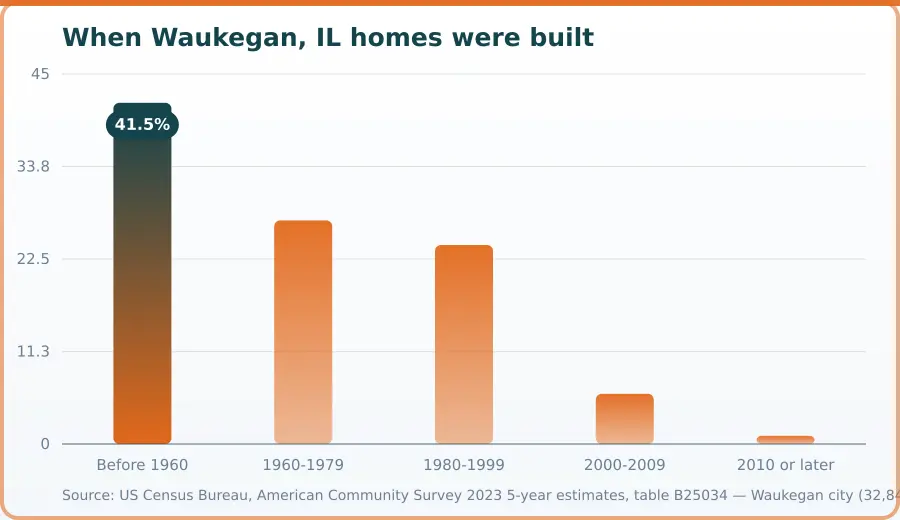
| Period | When homes were built (%) |
|---|---|
| Before 1960 | 41.5 |
| 1960-1979 | 27.2 |
| 1980-1999 | 24.2 |
| 2000-2009 | 6.1 |
| 2010 or later | 1 |
Source: US Census Bureau, American Community Survey 2023 5-year estimates, table B25034 — Waukegan city (32,842 housing units). Retrieved November 10, 2026.
Samsung Washer Repair FAQ — Waukegan, IL
Samsung washer repairs address issues like drum problems, water leaks, drainage failures, and control panel malfunctions. A technician will diagnose the specific fault, replace worn seals or pumps if needed, and test the machine before finishing. The scope depends on what's causing the breakdown—some repairs are straightforward part swaps, while others require deeper troubleshooting.
Waukegan Appliance Repair connects you with independent local providers who often have openings within days. Response times vary by provider availability and your schedule, but many technicians in the Waukegan area can arrange appointments quickly when your Samsung washer is out of commission. Contact the service to discuss your timeline.
Pricing for Samsung washer repairs depends on the part that failed, labor time, and whether the machine is still under warranty. Drum replacements, pump repairs, and electronic control board fixes vary in cost. The independent provider you're connected with will discuss estimated costs before starting work.
Clear the area around your washer so the technician can access it easily and check connections. If the machine won't drain, have towels ready. Describe what you noticed before it broke down—unusual noises, error codes, or when the problem started. This information helps the technician diagnose the issue faster.
Run cleaning cycles regularly, don't overload the drum, and use the right detergent amount. Waukegan's water supply carries minerals that can build up inside the machine, so periodic maintenance cycles help. Check hoses for cracks and ensure proper drainage to catch problems early before they become costly repairs.
The Chicago area experiences severe summer thunderstorms and occasional derechos that trigger power surges and outages. These electrical disruptions can damage Samsung washers' control boards and electronic components. If outages are common in your neighborhood—from Downtown Waukegan to areas like Beach Station—consider surge protection and unplug the machine during severe weather alerts.
More Ways We Can Help
More Repairs for This Brand
Homeowner Safety Toolkit
Confirm Who You're Hiring in Waukegan, IL
Before you hire anyone, use these independent national resources to confirm credentials, standards, and track record.
BBB
Look up any appliance repair company's complaint history, customer reviews, and accreditation status — a free, independent check before you hire.
Check StandingNFPA
A poorly repaired dryer, range, or water heater is a real fire risk. The National Fire Protection Association's home safety guidance covers what to check after any appliance service.
Appliance Fire Safety TipsISCET
NASTeC is the appliance repair industry's own national certification exam, administered by the nonprofit ISCET. It's voluntary, so it's worth asking whether your technician holds it.
About NASTeC CertificationBook your Waukegan appliance repair today.
Call (847) 656-4806Our Waukegan, Illinois Service Area
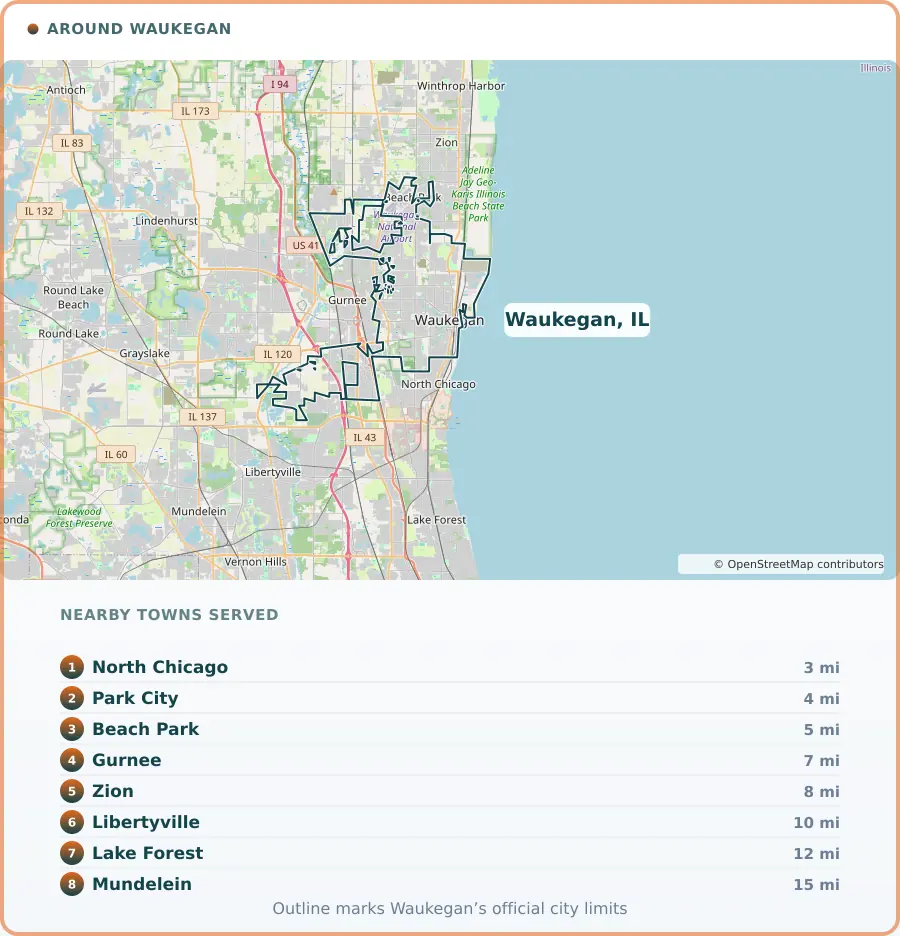
Waukegan, IL is the centre of the service area, which extends to 8 surrounding towns. The map shows how far that reaches.
About Waukegan, IL
Set along the Lake Michigan shoreline in Lake County, Waukegan is a harbor city of roughly 86,000 people where a strong manufacturing past has broadened into healthcare, education, and government work. The city's port and transportation connections still shape daily life, while retail and small manufacturing firms sit alongside a steadily growing service sector that keeps the local economy diverse.
Around downtown Waukegan and out toward Bowen Park, the community's institutions tell the story: Vista Medical Center East, Waukegan Community Unit School District 60, Lake County government offices, and the College of Lake County all anchor local employment, alongside everyday fixtures like Jewel-Osco and the Waukegan Park District. It's a working lakefront town that has long balanced industry with neighborhood life, and that blend still defines its character today.

Photo: edward P. steinburg desnged, CC BY-SA 3.0